Taste x Baseten
Own your intelligence, and add taste to it

Founder
Taste x Baseten
There’s been a movement of companies who are at the frontier of their fields wanting to own their intelligence. This means they’re post-training models for their exact use case, so it can either outperform on quality, cost, speed, or a combination of these, compared to frontier models.
We’re excited to announce our partnership with Baseten to help their customers post-train for subjective domains.
They bring the compute, we bring the environments (& taste)
The rise of the inference provider, like Baseten, came out of the open-source renaissance. In the model economy, more companies were looking to make use of their data and to train models to further make use of their own. Baseten is building the infrastructure and compute to make this possible. Most recently, they introduced Base Labs - a research arm, to help further the mission of open research at the frontier.
More and more, they’re helping their customers not just with the infra/compute, but with the knowledge required for post-training.
This is where we also come in. A huge part of getting post-training right, is getting data & grading right.
We’re working as an extension of the Base Labs applied research team to develop environments and offer learned reward signal as a service where correctness is the hardest to define.
Why subjective domains require a different approach
One of the powerful things these companies can do is train on their own data. And for deterministic domains, this has become an incredibly effective approach: analyze traces, find failure modes, build an eval for it, and hillclimb on said eval.
For subjective domains, this has been much harder, for a few reasons:
User data is noisy
It’s hard to “filter” your own data to understand what is truly high quality and what isn’t. Many users aren’t experts, and “don’t have taste” in that domain - so training on their data can actually regress model capabilities.
It’s hard defining what “great” is
For more deterministic domains, the “rubric” or “reward function” is clear. For more subjective ones, it isn’t. Defining the rubric and reward function are the hardest part, and they require deep domain expertise of a particular field.
There’s no “standard” benchmark to hillclimb
Building the right eval is incredibly important in order to make sure the right capabilities are being improved. We often work to build this benchmark or eval with customers first, which requires domain expertise and an opinionated view of what great is.
These types of problems span across use cases: vibecoding tools, generative platform, enterprise agents that need to output some type of visual artifact, coding agents that build front-ends, the list goes on. It’s not just about creative fields. It’s about appropriateness and fit.
How we’ll come in
We’re excited to work with Baseten’s customers to help them answer these questions. Define their evals, filter their data, define what great means in their domains. A process that requires deep collaboration, R&D and domain focus.
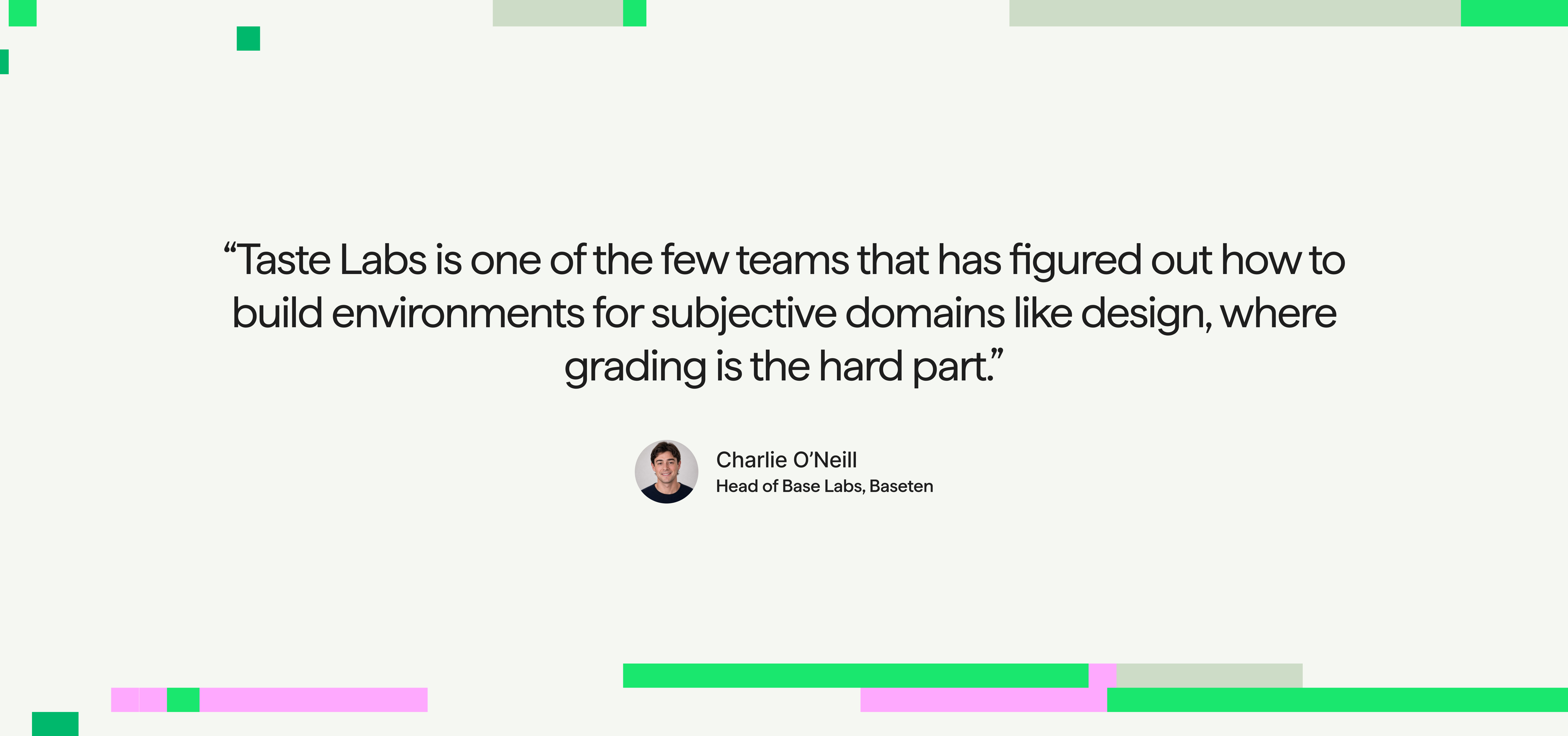
"Most RL environment work so far has gone into domains with a clear right answer. Taste Labs is one of the few teams that has figured out how to build environments for subjective domains like design, where grading is the hard part. In the real world, that's what our customers often need.", says Charlie O'Neill, Head of Base Labs.
Objective fields will saturate fast. The subjective ones will be an ever-evolving problem. We’re working to define the frontier.
This is just the beginning! If you’re excited to partner on similar problems, reach out at hello@tastelabs.com